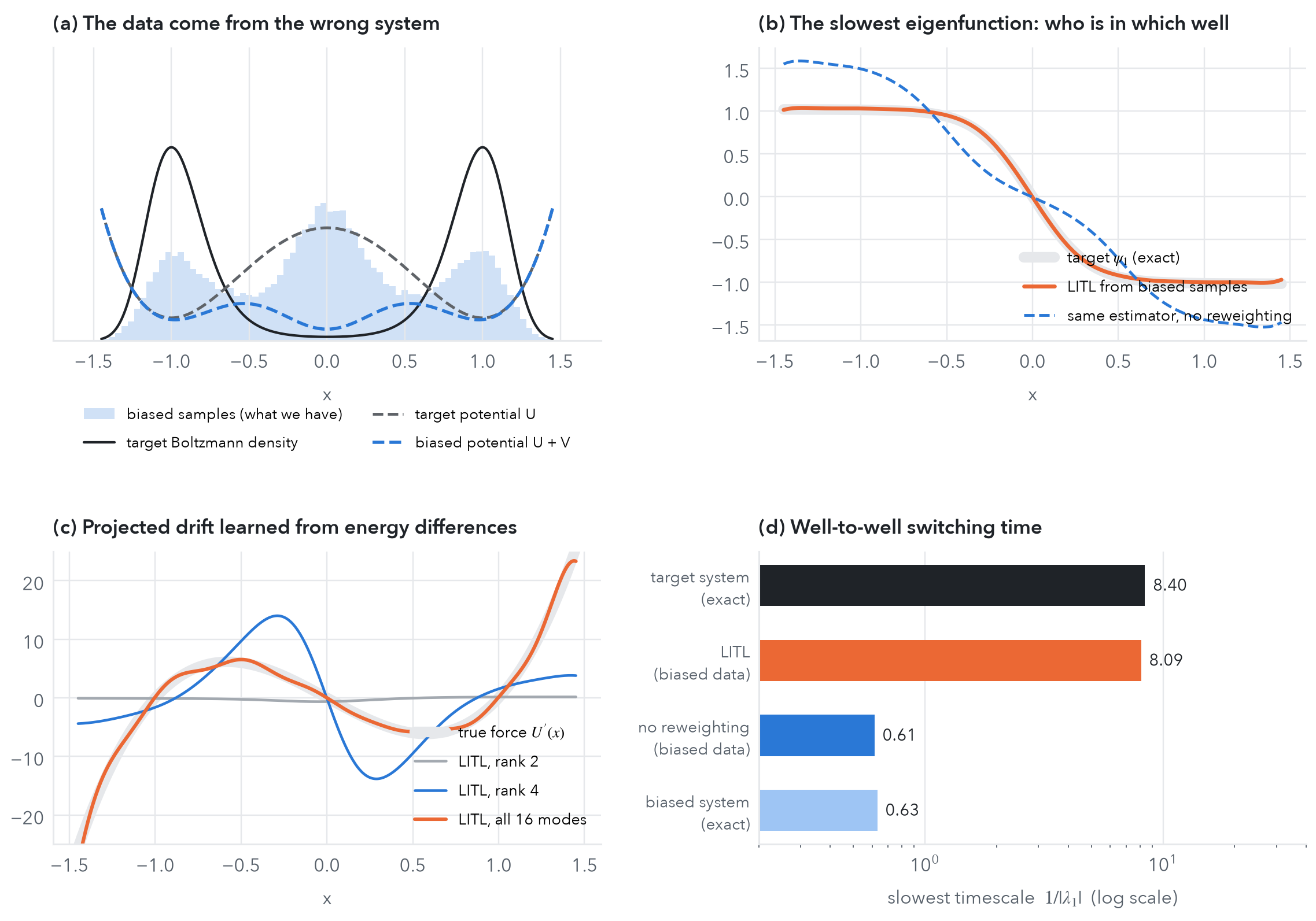
LITL learns the slow spectral structure and the projected drift of a target Langevin system from samples of a different, biased system plus black-box energy feedback. It comes with finite-sample guarantees in Sobolev norms and works for molecules, generative models, nanomagnets and latent steering of neural networks.